【AI-coding】A Verifiable Niche Discovery Tool for Indie Projects
Finding market needs is tough. Since I don’t want to sift through endless posts and news every day, I’ve spent the last couple of days upgrading my discovery tool using Claude and Gemini. It’s officially live and running smoothly.
The result:
A traceable, convenient, and practical discovery tool for indie project niches.
Core Value:
Traditionally, hunting for market needs online is a massive time sink. You have to comb through mountains of data and keep tabs on various market trends. This is especially true for indie projects. By leveraging AI to scrape and analyze specific pain points, you can save a significant amount of reading time. Efficiency = more possibilities for the future.
Features include:
[Important] Daily monitoring of the latest needs, with extraction of the original source text used to draw conclusions, sent via scheduled push notifications.
[Important] Niche filtering, allowing you to filter by industry or category to easily find areas where you excel.
Marking needs as viewed, saved, or not interested.
Date filtering.
One-click access to original source links.
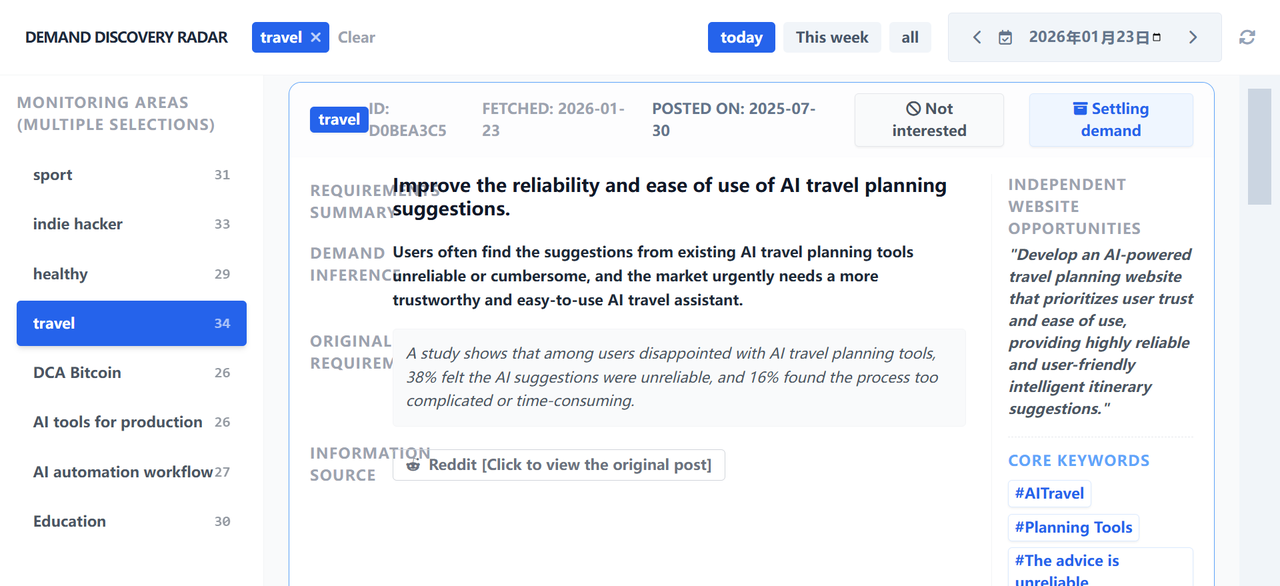
The Process:
A brief description
-
Front-end interaction was easy to build. I just told the AI exactly what features I wanted—this is the foundation of product design: knowing exactly what I need.
-
For web search, I’m using the Gemini API (free tier). It returns multiple needs at once, which is plenty for daily scheduled tasks. The prompting is the most critical part here.
-
The back-end is more complex, with tables and functions built on Supabase. This proved once again that designing a database structure isn’t just about making an Excel sheet. Professional work is best left to professionals; while it might look easy, it’s a case of "ten minutes of architecture, ten years of back-end experience." It’s not my forte, but I made sure it’s functional.
-
Scheduled tasks are hosted on GAS (Google Apps Script). Once the daily run is finished, it sends a notification via IM—chasing the ultimate information workflow integration.
-
Prompt optimization until I started getting reasonable results.
The Difficulty of Niche Hunting:
I previously saw someone on Reddit build a discovery tool, but the card content was so cluttered that it was hard to parse.
Plus, there was a logical flaw: he used the Reddit API to monitor results directly—basically scraping "keywords"—and then tried to judge every single hit. That’s no different from me manually browsing a bunch of posts. A massive selection is no selection at all.
I’ve also tried tools like Sukiwatch to monitor keywords. I set one for "AI tool," and after a week, I had over 2,000 Telegram messages. I abandoned it immediately.
True niche discovery comes from users describing their frustrations, not just filtering for keywords.
I used to do this manually with specific search queries; now, I just let AI handle the web search.
Despite this:
-
Localized content (niches) can feel far away; it's hard to get data on things happening in the real world.
-
There is too much digital noise online. In the AI era, everyone uses AI to write promotional fluff disguised as organic user posts.
-
There is a massive gap between a "trending buzzword" and an actual problem a user faces. Identifying a need still requires validation.
-
AI-coding is powerful, but it still requires some programming knowledge. This level of efficiency is clearly best suited for building demos. Real commercial projects still need a professional to oversee the big picture.
-
Most importantly, AI prompts require dozens of iterations to actually uncover genuine needs.
Lessons Learned:
-
The Gemini training data is stuck in the 1.5 era, and they keep changing my models on me, which has tripped me up several times.
-
I didn’t store historical data in tables initially, so data cleaning took forever. Claude eventually solved that for me.
-
Getting the script to run is the easy part; optimizing the AI model prompts took me a full week.
-
In reality, AI web search can provide links, but before it actually connects to the internet, it won’t proactively tell you if it's just hallucinating based on its training data.