【AI-coding】Flashcard Learning Tool – Forgetting Curve Edition
Having your own personalized collection of digital tools is becoming easier than ever to achieve.
However, for those outside the internet technology and product fields, the barrier to entry remains quite high.
Even with AI assistance, clearly defining your own requirements is still far from easy. Take this site, for instance:
miumiuwordlearn
This is a flashcard-based vocabulary learning tool I built for a family member. It took about 2 hours to go from 0 to 1, and about 3 days to iterate. Currently, it fully covers all requirements, though the process was quite arduous. (Yes, that's our cat in the top left corner.)
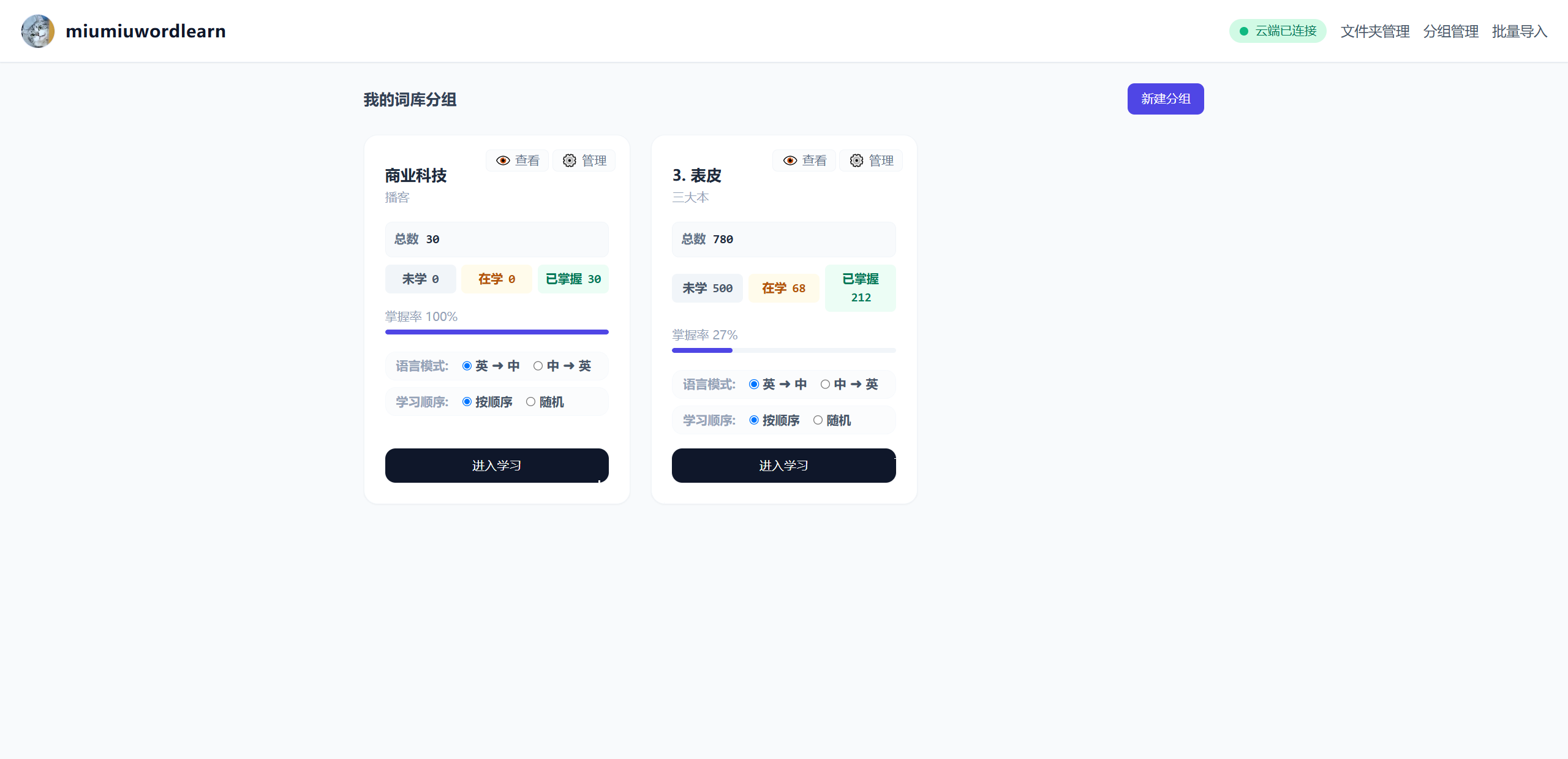
Results
What used to cost around 200 RMB per year is now deployed for free for personal use. Aside from electricity, the cost is practically zero—and I can iterate on it whenever I want.
The Process & Challenges
Why is this still difficult for people outside tech? The following process might explain a thing or two.
When I decided to build this site, it was because the app they were originally using (called something like Quizlet) required going to the web version to manage words (like editing or deleting), but the web version was extremely laggy. It didn't even have a search function, forcing users to hit Ctrl+F just to locate and edit a word. A family member got so frustrated over this that it ruined their morning. (Proof that a single small pain point can drive a user away.) So I said, "How about I build one for you?"
First, I asked what the requirements were. The answer I got was: "I want a vocabulary flashcard tool with favorites, tags, and two modes. Once in learning mode, I want two buttons: [Got It] and [Review Again]. Clicking the card should flip it." Meanwhile, I checked the original app, which had basic management functions.
I organized these requirements and had AI start writing the code. But very quickly, we hit the first roadblock. Words have three states: [Unlearned], [Learning], and [Mastered]. The logic governing how words transition between these states is actually quite complex. If we don't explicitly tell the AI the exact logic, it will never guess it in a million years—and consequently, it can't solve the problem that the user fails to clearly articulate.
The actual state transition logic:
-
Any action on an [Unlearned] word moves it to [Learning].
-
A word in [Learning] state only moves to [Mastered] if the user clicks [Got It] on its first review during a session.
-
Once a word reaches [Mastered], it never leaves this state.
-
Each learning session processes 10 words as a single batch. If [Review Again] is clicked, the word enters a loop within the current batch until [Review Again] has been clicked 3 times or [Got It] is selected, after which it exits the loop.
This kind of logic can only be mapped out through actual usage. How could an AI possibly guess it?
I won't dive into the details of the other logic, but after at least 8 version iterations (and deploying it 4 separate times), it finally stabilized.
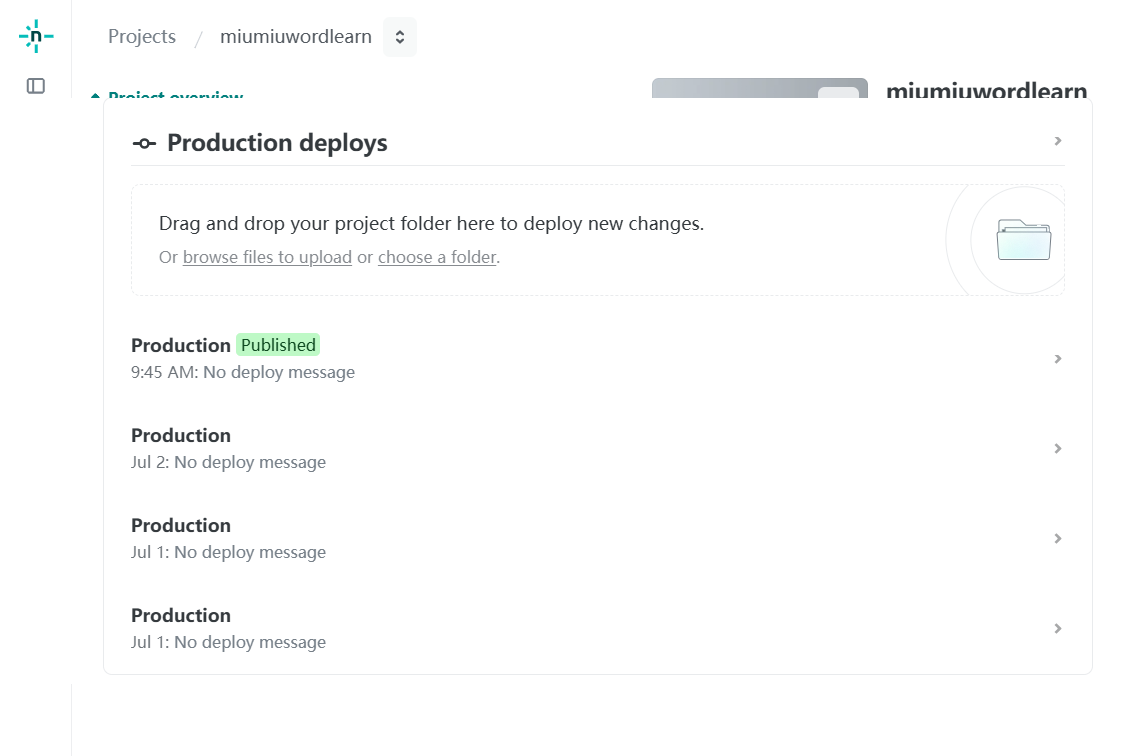
Not to mention the endless bugs the AI generated along the way.
At the very least, this flashcard tool now boasts a solid set of features, and iterations have become much less frequent.
This flashcard vocabulary tool includes the following features:
-
Batch Import Support: Supports multiple import modes and can detect and flag improperly formatted entries.
-
Card Deck Management: Organize words within decks for quick searching and editing.
-
Flexible Learning Modes: Supports Chinese-to-English and English-to-Chinese modes, with options for fixed-order or randomized memory sequences.
-
Interactive Flashcards: Click cards to reveal answers, complete with standard audio pronunciation output.
-
Organization: Supports folder categorization and sorting.
-
Smart State Tracking: Word learning states support multiple stages aligned with memory and review logic.
Conclusion
Personal-use flashcard learning tools should remain ultra-minimalist—focusing strictly on core functionality. Since there's no commercialization, there's no need for unnecessary fluff, nor is there any need for ads.
So, even though countless AI vendors today claim their tools can generate a website in a single step, making it usable and handling complex logic correctly still requires domain expertise—or at least strong logical breakdown and communication skills.
In reality, even if a site can be generated instantly, data and business operations remain irreplaceable. For example, if you build a replica of the Amazon website, no one will come because actual merchants aren't on it.
On the flip side, lightweight, hyper-focused web pages are perfect for personal use. This enables niche groups to have tools that are perfectly customized to their exact needs.
For now, this vocabulary flashcard site is performing great and feels exceptionally smooth to use.
If you have similar needs, feel free to contact us via email.
We will continue to build even better and more useful websites in the future.