【Product Thought】How to Use Automated Xiaohongshu Trend Monitoring for Market Research
Xiaohongshu (RedNote) has become an important data source for brands researching Chinese consumer trends, product demand, and content performance. Millions of creators, brands, products, posts, and user comments generate valuable market signals every day.
Through automated xiaohongshu trend monitoring, brands and market analysts can continuously track key categories, competitors, and influential creators to identify emerging consumer interests, popular products, and changing market demands.
Compared with one-time research projects, continuous rednote trends monitoring helps companies build a long-term market observation system. Brands can understand which products are gaining attention, which content formats are growing rapidly, what consumers are discussing, and how competitors are positioning themselves.
Why Do Brands Need Automated Xiaohongshu Trend Monitoring?
For companies entering the Chinese market or researching Chinese consumer behavior, Xiaohongshu is more than a social platform. It is also a valuable channel for consumer decision-making and market intelligence.
Through continuous xiaohongshu trend monitoring, brands can gain insights into:
Discover Market Trends Faster
Consumer interests, product discussions, and content trends can change quickly.
Automated data collection from selected categories and creators allows brands to identify early signals before trends become mainstream. Instead of discovering market changes after competitors have already reacted, companies can monitor evolving demand in real time.
Reduce Market Research Costs
Manually browsing thousands of posts, collecting information, and creating reports requires significant time and resources.
Automation allows teams to collect and organize data at regular intervals, enabling researchers to focus on analysis and business decisions instead of repetitive data collection.
Reduce Product Launch and Advertising Risks
Before launching a product or investing heavily in advertising, brands can use market research to understand:
-
What target customers are discussing
-
How users respond to competitor products
-
What problems customers experience
-
Which product features receive the most attention
These insights help brands improve product positioning and marketing strategies before entering the market.
Understand Competitive Positioning
By monitoring multiple competitors, brands can compare:
-
Content volume
-
User engagement
-
Product positioning
-
Consumer feedback
-
Marketing strategies
Long-term data accumulation helps companies understand their position in the market and identify areas where competitors are increasing investment.
Why Manual Xiaohongshu Research Is Difficult to Scale
Manual search and analysis can work for small research projects. However, when monitoring multiple brands, categories, and creators, efficiency decreases quickly.
Large Data Volume
A single research project may require tracking:
-
Multiple competitor brands
-
Dozens of keywords
-
Hundreds of creators
-
Thousands of posts and comments
-
Daily content updates
Relying completely on manual research makes it difficult to maintain consistent coverage.
Easy to Miss Emerging Trends
Rednote trends can develop quickly.
A product, keyword, or content format may gain popularity within days. Weekly or monthly manual research often misses the early stage of trend growth.
Difficult Data Standardization
Traditional research methods usually rely on screenshots, spreadsheets, and manual notes.
Different researchers may record information differently, making comparison and long-term analysis difficult.
Automated collection creates consistent data structures, time ranges, and categories, allowing companies to compare changes over time.
Too Much Repetitive Analysis Work
The value of market research is not simply finding one viral post. The real value comes from identifying repeated patterns across large amounts of data.
For example:
-
Which products continue growing?
-
Which keywords appear repeatedly?
-
Which content formats generate higher engagement?
-
Why do users like or dislike certain products?
When data volume increases, automation significantly improves research efficiency.
What Data Matters Most in Xiaohongshu Market Intelligence?
Not all data has equal business value. For brands and analysts, the key is building a data system that supports market research, competitor tracking, and strategic decision-making.
1. Category and Trend Data
Important indicators include:
-
Category keywords
-
Trending topics
-
Publishing time
-
Content growth rate
-
Engagement metrics
-
Likes, saves, and shares
-
Creator levels
-
Category popularity changes
For example, when a keyword continues growing for several weeks and related content receives increasing engagement, it may indicate that a new market opportunity is forming.
2. Content Performance Data
For high-performing content, brands can analyze:
-
Frequently used keywords
-
Product selling points
-
Content themes
-
Image structures
-
Video formats
-
Content length
-
Common content patterns
-
Expressions frequently used in successful posts
This helps brands understand what consumers actually care about instead of only knowing which products are popular.
3. User and Comment Data
Comments often provide deeper consumer insights than basic engagement metrics.
Brands can analyze:
-
Frequently mentioned words
-
Customer questions
-
Product usage feedback
-
Positive and negative opinions
-
Desired features
-
Purchase motivations
-
Opinions about competitors
Large-scale comment analysis can reveal customer needs and product pain points.
Building an Automated Xiaohongshu Monitoring Workflow
An effective xiaohongshu trend monitoring workflow is not only about collecting data. It requires defining monitoring goals and creating a structured research process.
Step 1: Define Monitoring Categories
First, determine the industries and areas to monitor:
-
Beauty and skincare
-
Fashion
-
Food and beverage
-
Consumer electronics
-
Parenting products
-
Home products
-
Cross-border e-commerce
A clear category definition makes keyword filtering and data analysis more effective.
Step 2: Define Monitoring Targets
Different goals require different datasets.
Competitor Monitoring
Track:
-
Brand names
-
Product names
-
Brand keywords
-
Competitor creators
Trend Monitoring
Track:
-
Category keywords
-
Trending topics
-
Emerging products
-
Fast-growing keywords
Customer Research
Track:
-
Product-related comments
-
Customer pain points
-
Purchase feedback
-
Frequently asked questions
Step 3: Set Monitoring Frequency
Monitoring frequency depends on industry speed.
Fast-moving consumer goods usually require more frequent updates, while products with longer purchase cycles can be monitored less frequently.
Step 4: Automatically Collect Data
Convert monitoring targets into structured datasets and collect:
-
Post data
-
Creator information
-
Engagement data
-
Comment data
-
Trending topics
This eliminates the need for researchers to manually search every day.
Step 5: Clean and Organize Data
Raw data usually contains duplicate and low-value information.
Common processing steps include:
-
Removing duplicates
-
Categorization
-
Filtering irrelevant data
-
Keyword grouping
-
Brand classification
-
Timeline organization
Step 6: Use Data for Further Analysis
Collected data can support:
-
Trend analysis
-
Competitor monitoring
-
Customer research
-
Content analysis
-
Product research
-
Market reports
-
Automated alerts
The goal is not collecting more data, but turning data into actionable business insights.
Practical Example: Beauty, Fashion, and Consumer Brands
Different industries can create their own brand monitoring and competitor tracking systems based on business goals.
Case Study: Using Beauty Creator Data to Understand Consumer Trends
Taking beauty creator Daily-cici as an example.
According to third-party social media analytics, public content performance was analyzed during the tracking period:
-
Content analyzed: 57 posts
-
Estimated media value: $908,400
-
Average media value per post: $15,900
-
Average posting frequency: approximately one post every 1.23 days
Daily-cici creates beauty-related content including skincare advice, product recommendations, and lifestyle content.
For posts involving major beauty brands such as L'Oréal Paris, brands can analyze engagement performance and combine comment data to understand real consumer reactions.
A single post provides limited insight.
However, comparing multiple creators, brands, and products allows companies to discover:
-
Which brands appear more frequently
-
Which products receive more attention
-
Which ingredients become popular discussion topics
-
Which content formats generate stronger engagement
-
What feedback users commonly provide
-
Which keywords continue growing
This demonstrates the value of automated xiaohongshu trend monitoring: not just finding one viral post, but identifying repeated market patterns through continuous data collection.
Frequently Asked Questions
How Often Should Brands Monitor Xiaohongshu Trends?
It depends on industry speed and research goals.
For beauty, food, fashion, and other fast-moving consumer categories, brands may monitor creators, brands, and categories daily.
For furniture, appliances, automobiles, and other longer purchase-cycle industries, weekly or longer monitoring periods may be more appropriate.
The key is matching monitoring frequency with business objectives.
Can Xiaohongshu Data Be Used for Professional Market Research?
Yes, when used correctly.
Xiaohongshu data is especially useful for:
-
Consumer trend research
-
Product demand discovery
-
Competitor analysis
-
Content research
-
User feedback analysis
-
China market entry research
However, it should be combined with other sources such as sales data, advertising data, customer surveys, and industry reports for major business decisions.
What Should Brands Look for in an Automated Xiaohongshu Monitoring Tool?
Important factors include:
-
Data coverage
-
Update frequency
-
Bulk data processing capability
-
API availability
-
Data field completeness
-
Historical data support
-
Export options
-
Data security
For companies that need long-term competitor tracking and brand monitoring, stable data collection and scalable processing are usually more important than one-time searches.
Start Xiaohongshu Trend Monitoring
If your goal is to continuously research Chinese consumer trends, competitor activities, and popular content, building an automated data collection workflow is more effective than conducting occasional manual research.
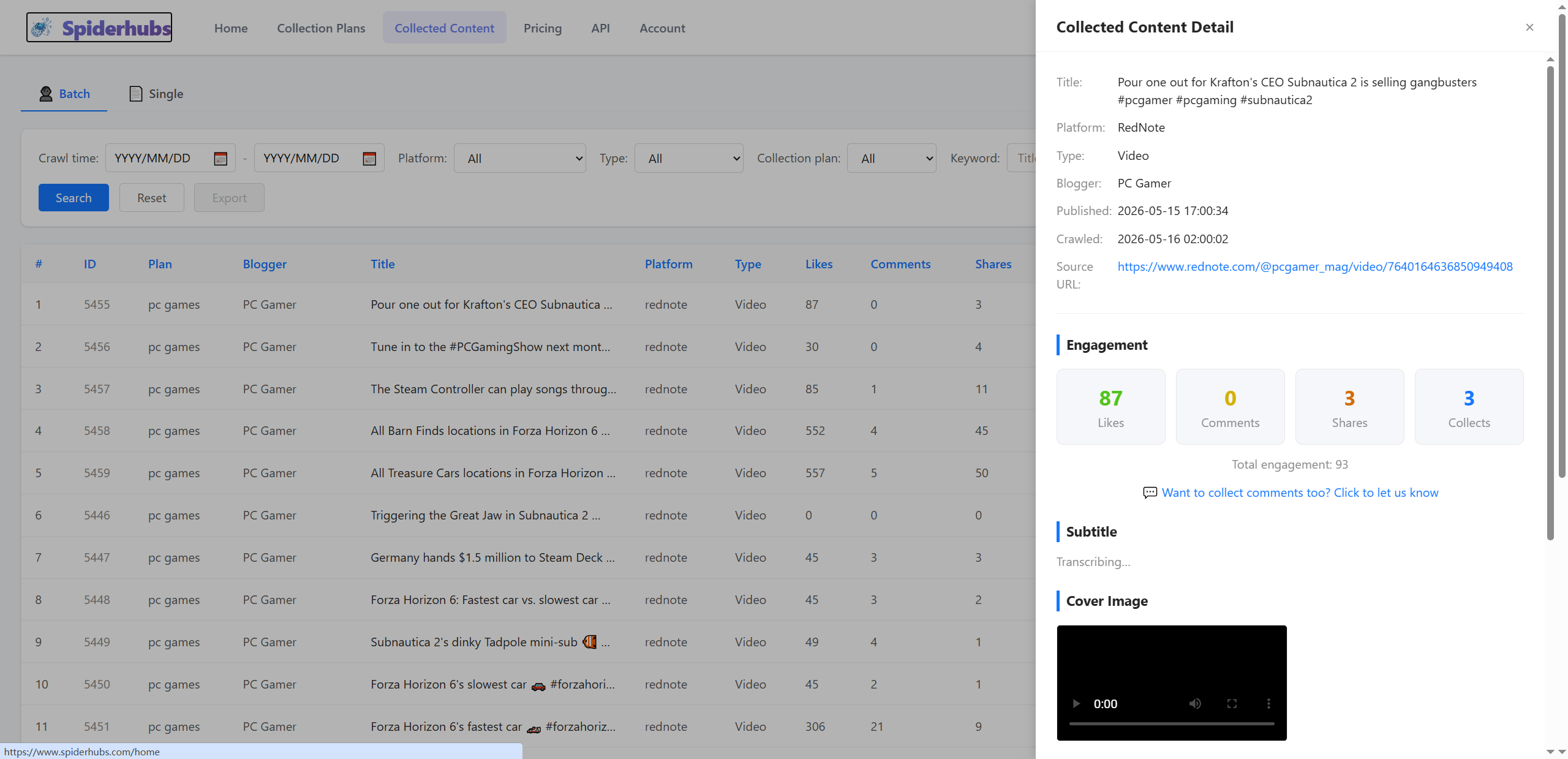
SpiderHubs provides automated Xiaohongshu (RedNote) data collection capabilities for trend research, competitor monitoring, creator analysis, and market data gathering.
It supports individual researchers and small teams conducting cost-effective market research, as well as MCN agencies, brand teams, and data organizations requiring large-scale data collection.
Start here:
For large-scale data collection, new website data requirements, or customized scraping needs, contact: