【Product Thought】RedNote API Complete Guide: How to Access and Analyze Xiaohongshu Data
If you are conducting market research, competitor analysis, brand monitoring, or social media data analysis, a RedNote API (also known as a Xiaohongshu API or Xiaohongshu data API) can help you turn publicly available Xiaohongshu content into structured data.
Compared with manually copying posts, taking screenshots, and organizing information in Excel, an API is better suited for continuously collecting and analyzing large volumes of Xiaohongshu content.
This guide explains what a RedNote API can do, what types of data you can typically access, and how brands and data analysts can use Xiaohongshu data for market research.
What Is a RedNote API?
A RedNote API is an interface that allows applications to programmatically access Xiaohongshu data.
Developers can use API requests to retrieve specific types of information and then convert the returned data into JSON, database records, CSV files, or other structured formats for further analysis.
Common data types include:
-
Post lists
-
Post details
-
User and creator information
-
Comments
-
Search results
-
Trending or topic-related data
-
Post engagement metrics
The exact fields available depend on the API provider and the data access available through each specific interface.
For example, SpiderHubs provides APIs for multiple social platforms and uses API keys for authentication.
View the SpiderHubs API documentation
Why Do Brands Need Structured RedNote Data?
Information on Xiaohongshu is primarily published as posts, images, videos, and comments.
If analysts rely entirely on manual research, they need to repeatedly copy titles, post content, likes, saves, and comments and then organize the information in Excel.
By contrast, structured data can convert this information into standardized fields such as:
Data FieldExampleNote IDUnique post identifierTitlePost titlePublish TimePublication timeLikesNumber of likesCollectsNumber of savesCommentsNumber of commentsTagsTopic tagsAuthorCreatorContentPost content
This makes the data easier to query, store, analyze, and process with AI.
1. Competitor Monitoring
Brands can continuously collect posts from competitors and compare:
-
New post publishing frequency
-
Likes and saves
-
Frequently used keywords
-
Common content topics
-
Creator collaborations
-
Proportion of high-performing posts
For example, a company can build a competitor monitoring database and automatically update it with new content every day.
2. Content Analysis
Once large volumes of posts have been converted into structured data, analysts can examine:
-
Which keywords appear most frequently
-
Which title structures are most common
-
Which content topics generate higher engagement
-
Which topics are gaining attention
-
Which marketing messages different brands use
This is more suitable for large-scale research than manually reviewing a few dozen posts.
3. Consumer Insights
Comments often contain valuable feedback from users.
With structured comment data, analysts can identify phrases such as:
-
“Where can I buy it?”
-
“How much is it?”
-
“How do I order?”
-
“Avoid this product”
-
“Doesn't work”
-
“Pills up”
-
“Caused irritation”
These comments can then be classified using keywords or AI to identify common consumer needs.
It is important to distinguish the data collection layer from the analysis layer. An API provides the underlying data, while sentiment analysis, keyword classification, and purchase-intent detection are normally performed as additional processing steps.
What Data Can You Get Through a Xiaohongshu Scraper API?
The fields available through a xiaohongshu scraper api vary between providers and individual endpoints, so the API documentation should always be used as the final reference.
The following categories are commonly relevant.
Post Data
Typical fields may include:
-
Post ID
-
Title
-
Text content
-
Publication time
-
Post type
-
Image information
-
Video information
-
Topic tags
-
Location information
-
Engagement metrics
Some endpoints may also provide additional media resources or platform-specific fields.
Engagement Data
Common social engagement metrics include:
-
Likes
-
Saves
-
Comments
-
Other engagement metrics supported by the platform or API
These metrics can be used to calculate engagement rates, compare post performance, and identify high-performing content.
The exact fields should be verified against the relevant API endpoint because different interfaces may return different data.
Creator Data
Some creator or user endpoints may provide:
-
User ID
-
Username
-
Avatar
-
Profile description
-
Follower-related metrics
-
Total likes and saves
This information can be used to build creator databases and support KOL/KOC research.
Comment Data
Comment endpoints can typically be used for:
-
Comment text
-
Comment timestamps
-
Comment engagement data
-
Comment replies
-
Keyword analysis
For example, a skincare brand can collect comments from competitor posts and count how frequently terms such as “pilling,” “irritation,” “greasy,” or “strong fragrance” appear.
This can help identify the issues users discuss most frequently.
Search and Trending Data
If an API provides search or ranking endpoints, they can also be used for:
-
Keyword searches
-
Post searches
-
Trending content discovery
-
Trending-topic monitoring
-
Topic analysis
These capabilities are particularly useful for market research and trend monitoring.
RedNote API vs. Manual Data Collection
ComparisonRedNote APIManual CollectionCollection methodAutomated requestsManual browsing and copyingBatch processingSuitableLess efficientData formatStructured dataUsually requires manual organizationContinuous monitoringCan be automatedRequires ongoing manual workData analysisEasy to send to databases/scriptsRequires additional preparationDevelopment costRequires technical integrationLow initial costLong-term maintenanceRequires API maintenanceRequires continuous human effort
The main advantage of a RedNote API is not simply replacing one manual search. Its value is turning repetitive data collection into a process that can run continuously.
How to Use RedNote Data for Competitor Analysis
A typical workflow looks like this:
Keywords → Search Posts → Get Post Details → Get Engagement Data → Get Comments → Store Structured Data → AI Analysis
For example, a beauty brand can continuously monitor content related to its competitors.
First, collect relevant competitor posts and then sort them by publication time, likes, saves, or comments.
High-performing content can then be analyzed to determine:
-
Which keywords are used in the titles?
-
Which product benefits are emphasized?
-
Which topics or hashtags are used?
-
What types of creators are involved?
-
What are users discussing in the comments?
The result can be a structured competitor content database that supports ongoing analysis.
How to Find Product Pain Points from Comments
Comment data is particularly useful for text analysis.
For example, a brand could analyze 10,267 comments about a skincare product (Mirror*) collected between June 2023 and June 2024 and identify frequently occurring terms:
User FeedbackFrequencyPilling1,245Too oily832Irritation621Strong fragrance487Absorbs quickly936
These numbers alone do not prove that a product has a quality problem. However, they can help researchers identify user feedback that deserves further investigation.
AI classification can also organize comments into categories such as:
-
Product functionality
-
User experience
-
Price
-
Packaging
-
Fragrance
-
Purchase intent
-
After-sales issues
This can provide a deeper view of consumer feedback than simply counting likes.
How to Use RedNote Data for Brand Monitoring
For brands with an established market presence, a continuous monitoring system can be useful.
A typical workflow could look like this:
Daily Collection → Data Storage → Keyword Detection → AI Classification → Anomaly Detection → Team Notification
If mentions of a brand or product increase significantly within a short period, the system can investigate further:
-
Was there a new product launch?
-
Did a viral post cause the increase?
-
Are consumers discussing the same issue?
-
Has there been a sudden increase in negative feedback?
The API is only the data collection layer. Anomaly detection, AI classification, and notification systems need to be implemented as part of the company's own data workflow.
RedNote API Compliance Considerations
Using a xiaohongshu scraper api can reduce the technical cost of data collection, but data sources and data-processing methods vary between providers. Some services integrate data from third-party public data sources rather than directly connecting to or collecting data from Xiaohongshu.
SpiderHubs provides third-party data integration services. The specific data sources and permitted uses should be evaluated according to its current service documentation and applicable agreements.
Users should also ensure that their own collection, storage, analysis, and use of API data comply with applicable platform rules and laws.
How Much Does a Xiaohongshu Data API Cost?
The pricing of a xiaohongshu data api varies between providers. Pricing models may be based on:
-
Number of API requests
-
API credits
-
Successful requests
-
Data type
-
Batch request volume
For example, SpiderHubs uses a credit-based model in its API documentation and applies different request limits to different endpoints.
Pricing and usage policies can change, so it is best to check the current API documentation and account page before integrating the service into a production workflow.
View the SpiderHubs API documentation
How to Get Started with a RedNote API
If you want to integrate Xiaohongshu data into your own application, the process typically involves several steps:
-
Register for an API service.
-
Create an API key.
-
Select the required data endpoints.
-
Send HTTP requests according to the API documentation.
-
Receive JSON responses.
-
Store the data in a database or analysis tool.
-
Apply keyword analysis, trend analysis, or AI classification according to your business requirements.
In practice, API keys are often passed through HTTP request headers. The exact authentication method should always be verified in the documentation of the specific API provider.
Who Can Benefit from a RedNote API?
A RedNote API is particularly useful for organizations and developers that need to process Xiaohongshu data at scale.
Brands
Common use cases include:
-
Competitor monitoring
-
Brand monitoring
-
Consumer research
-
Product research
Market Research Firms
Common use cases include:
-
Social media research
-
Industry trend analysis
-
User feedback analysis
-
Content research
MCNs and Creator Agencies
Common use cases include:
-
KOL/KOC discovery
-
Creator data analysis
-
Content performance analysis
-
Competitor creator monitoring
Software Developers
A xiaohongshu scraper api can be used as a data layer for applications such as:
-
RedNote data analysis tools
-
Xiaohongshu monitoring tools
-
Social listening platforms
-
Competitor monitoring software
-
Market research platforms
Conclusion
The core value of a RedNote API is turning Xiaohongshu content into structured data that can be processed by software.
For someone who only needs to check a few posts occasionally, manual research may be sufficient.
However, if you need to monitor hundreds or thousands of posts, track competitors and keywords continuously, or analyze creator and consumer feedback at scale, an API can become an important part of an automated data workflow.
A typical workflow looks like this:
RedNote Data API → Structured Data → Database → AI Analysis → Market Insights → Business Decisions
If you are looking for a Xiaohongshu data API, you can explore the current API endpoints and field documentation provided by SpiderHubs.
SpiderHubs RedNote / Xiaohongshu API
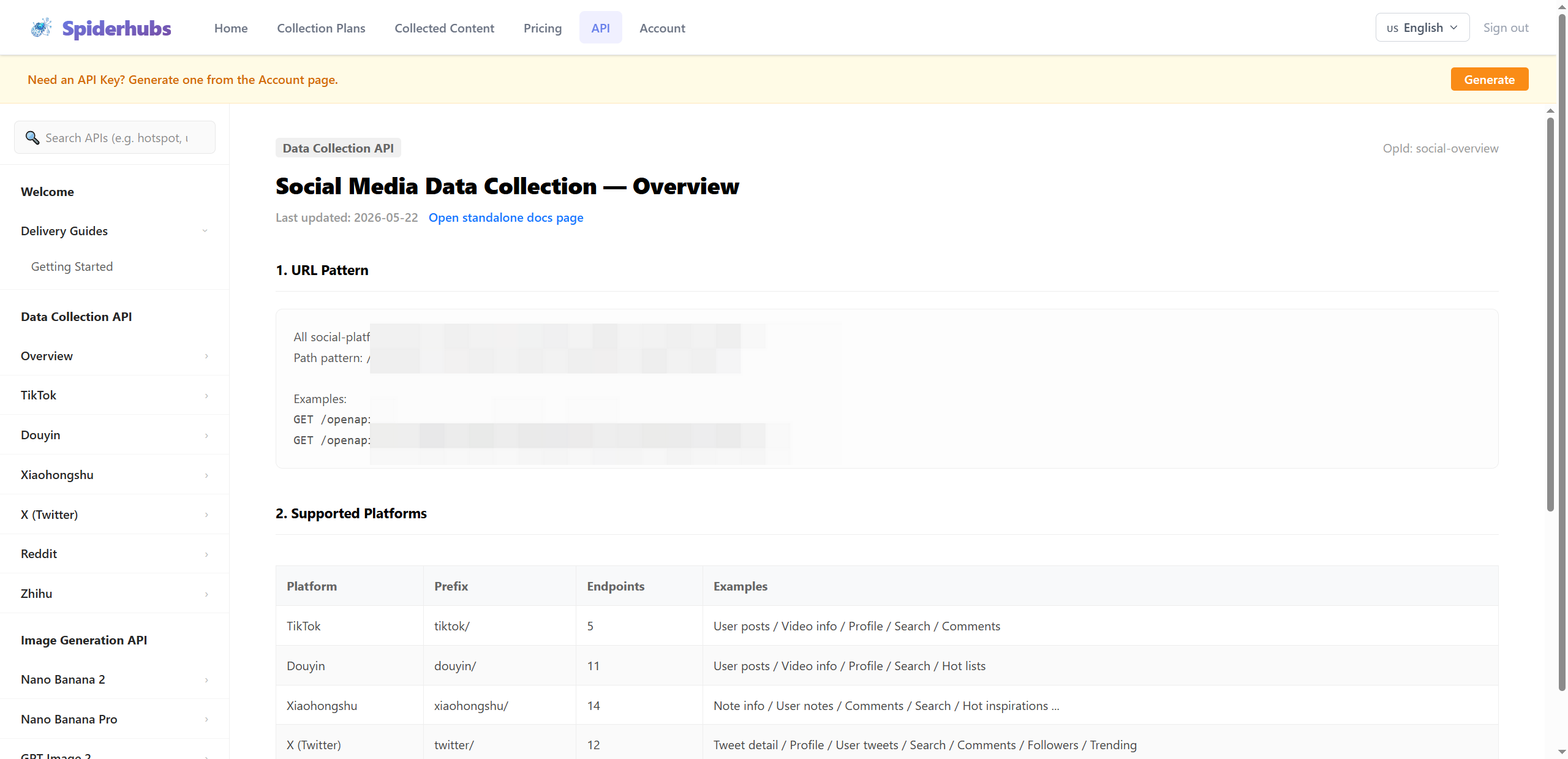
For API integration, data fields, or other platform APIs, you can also contact SpiderHubs. Available services include TikTok API, Douyin API, Xiaohongshu (RedNote) API, X (Twitter) API, Reddit API, and Zhihu API.
Contact: yizhiwangxing@gmail.com